 Core Rules & World Bible
The complete guide to the campaign setting

You're an adventurer. You may even be the son of a noble, but you are not legitimate. So you go beyond the boundaries of civilization, in pursuit of ancient secrets — exploring ruins, braving monsters' lairs, carving out a name for yourself and your company.
Whatever the courts and the castles have to offer, none of it was ever going to be yours — not as Human, not as Aelár born without a homeland to inherit, not as Vartran carrying a name the Church of Tar'amaan already hates on principle. Something always closes the door first. What's left is the road: contracts, ruins, and monster lairs, worked because the alternative was disappearing quietly where nobody would notice.
Sonata - Swords & Darkness is a dark fantasy retroclone of the most famous role-playing game's second edition, built on the For Gold & Glory's foundation and set entirely inside the Known World. Death is real, resources are finite, and mercenary work exists in the first place because civilization has already failed enough people to keep the trade in business.
Nine ancestries are open to play, human included, and a class is a trade learned, not a destiny handed down. Warriors train as Fighter, Paladin, Ranger, or Champion. Wizards work as Mage or Sorcerer. Priests serve as Cleric or Druid — though only Húldar and Aelár may walk the Druid's path; anyone else who tries is hunted as a thief by the Hyerophancy's own agents. Rogues run Thief or Bard. Ten classes, nine ancestries, and every combination has its own reason for being out here instead of somewhere safer.
What there is to do hasn't changed since the first table sat down to play: dungeons cleared, wilderness crossed, downtime spent between jobs — hirelings retained, wounds mended, coin banked or burned. The difference is what it can add up to. The Vithurian Orchestra turns notable deeds into songs, and nobody starts eligible for one; a company earns that attention the same hard way they earned everything else. Agents investigate. Reports get filed. And somewhere down the road, the same court that never opened its doors might finally have a reason to remember your name.
I started writing this game years ago, and I made a promise to myself to make it freely available. Everything you see here is the entire game (although still a work in progress), and you may feel free to play it as you see fit. The system is based on AD&D 2nd Edition, but there are many changes to the mechanics. A guide has been provided at the end of this page to help you use these mechanics with your favorite old-school books.
Sonata - Sword & Darkness™ is an Open Game License interpretation of Zeb Cook's 2nd Edition rules. All material contained within is free for use, distribution, remix, adaptation, and building upon the material in any medium or format, for noncommercial purposes only, as per the Creative Commons Attribution-NonCommercial 4.0 International license.
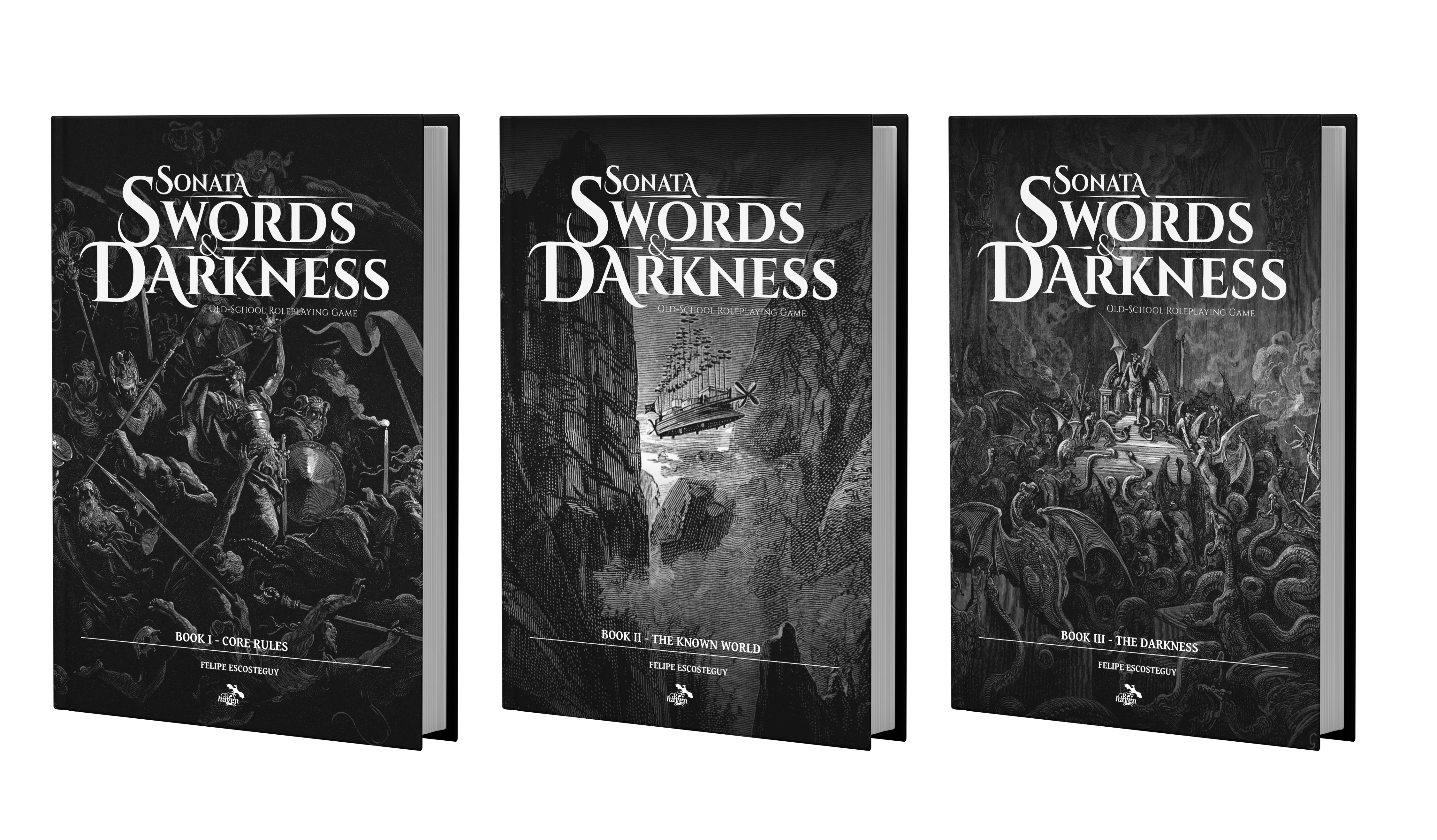
All the content is divided throughout three books, each playing their own part. Apart from that, you will need a set of dice with d4, d6, d8, d10, d12, and d20 - the same one you use when you play any edition of Dungeons & Dragons. Character sheets can be found in the Download section below.
BOOK I - CORE RULES - This book has all the mechanics you need to play - from character creation to how combat and downtime works, and so on. It's the most recommended starting point for both players and the gamesmaster.
BOOK II - THE KNOWN WORLD - There are no rules covered in this book, only detailed information about the setting. Although the first book explains briefly all the ancestries and cultures of the Known World, Book II is where you learn all you need to create your own campaign.
BOOK III - THE DARKNESS - This book has information more suited for the Gamesmaster, like the bestiary, rules for magic items, and more. Although players won't find any spoilers, they can skip this one if they want.
Sonata - Swords & Darkness runs on the For Gold & Glory foundation, itself a retroclone of the most famous role-playing game's second edition modernized in a few specific places.
If you would like to get in touch with me, feel free to shoot an email.
Felipe Escosteguy - Sao Paulo, Brazil - escosteguy.rpg@gmail.com